

When to Speak Up
A PA's guide to pitching
You’re young, you’re full of ideas. You’ve got a fresh perspective and you’re not beholden to the old way of doing things. You’ve also never produced a TV series or directed a multi-million dollar film.
You were hired to do a specific job, and it probably wasn’t to give the writer notes. But on the other hand, it doesn’t take a chef to know when the food is bad. We’ve all worked on crappy productions that we would’ve wanted to save from the idiots at the tops of the call sheet.
So when is an appropriate time to speak up? Some people will tell you the answer is “Never, shut up.” While that’s not necessarily a bad rule of them, it’s also not entirely true, especially on a show led by creative, collaborative people.
(Just don’t actually call them idiots.)
First, Safety
Quick caveat. I’m here talking about “speaking up” with regard to creative input. If it’s a safety issue, you should always speak up, especially if someone is in immediate, imminent danger.
But I’ll save that discussion for another post.
Ending Endgame
There’s a famous story about Jeff Ford, the editor of Avengers Endgame, reviewing a cut with the Russo brothers.
The filmmakers had tried several different lines for Tony Stark to say in reply to [spoiler alert for a six year old movie you’ve definitely seen] Thanos raising the Infinity Gauntlet and intoning “I am inevitable.” They finally settled on a version of the scene where Stark simply raises his own begauntleted hand without saying a word, revealing he has the stones.
At that moment, Ford kinda says under his breath, “I am Iron Man.”
The Russos sat up. “What did you say?”
“Well, if he’s inevitable, who’s he?” Ford asked. “He’s Iron Man. It’s full circle to the first movie.”
They immediately called up Robert Downey Jr., who didn’t want to come back for yet another reshoot. But the directors told him the line and RDJ paused, then said, “Dammit, yes, we have to shoot that.” And that turned out to be the very last shot filmed for the movie.
Anyway, that’s how I heard it. It’s not exactly how the Russos described the story recently in their Pizza Film School podcast, but I like the version I heard, so I’m telling you that.
Grip Com
Here’s a far less famous story from a sitcom I PA’ed on.
It was an office show, and in this particular episode, the goofball character had locked himself in a supply closet. It was a running gag throughout the episode, just something you could cut to for a quick laugh while the story advanced in the A and B plots.
During the production meeting, the writers mentioned they didn’t have a good button to the sequence.1 What was in the script was a placeholder, and they planned to change it. They just needed to come up with a funny gag involving office supplies. (On a TV schedule, you go into production with the script you have and hope you can figure it out.)
The meeting continued on unremarkably, except I noticed the key grip (who usually sat back to the wall rather than at the conference room table), leaned forward and grabbed a couple of highlighters. He saw me see him, and gestured for me to grab the cup full of highlighters at the end of the table.
My guy, how many highlighters do you need? But I handed it to him anyway, because I was the PA and what do I know?
He started snapping them together, making a big stick out of them. You know, that thing every human being with access to two or more highlighters has done at least once?
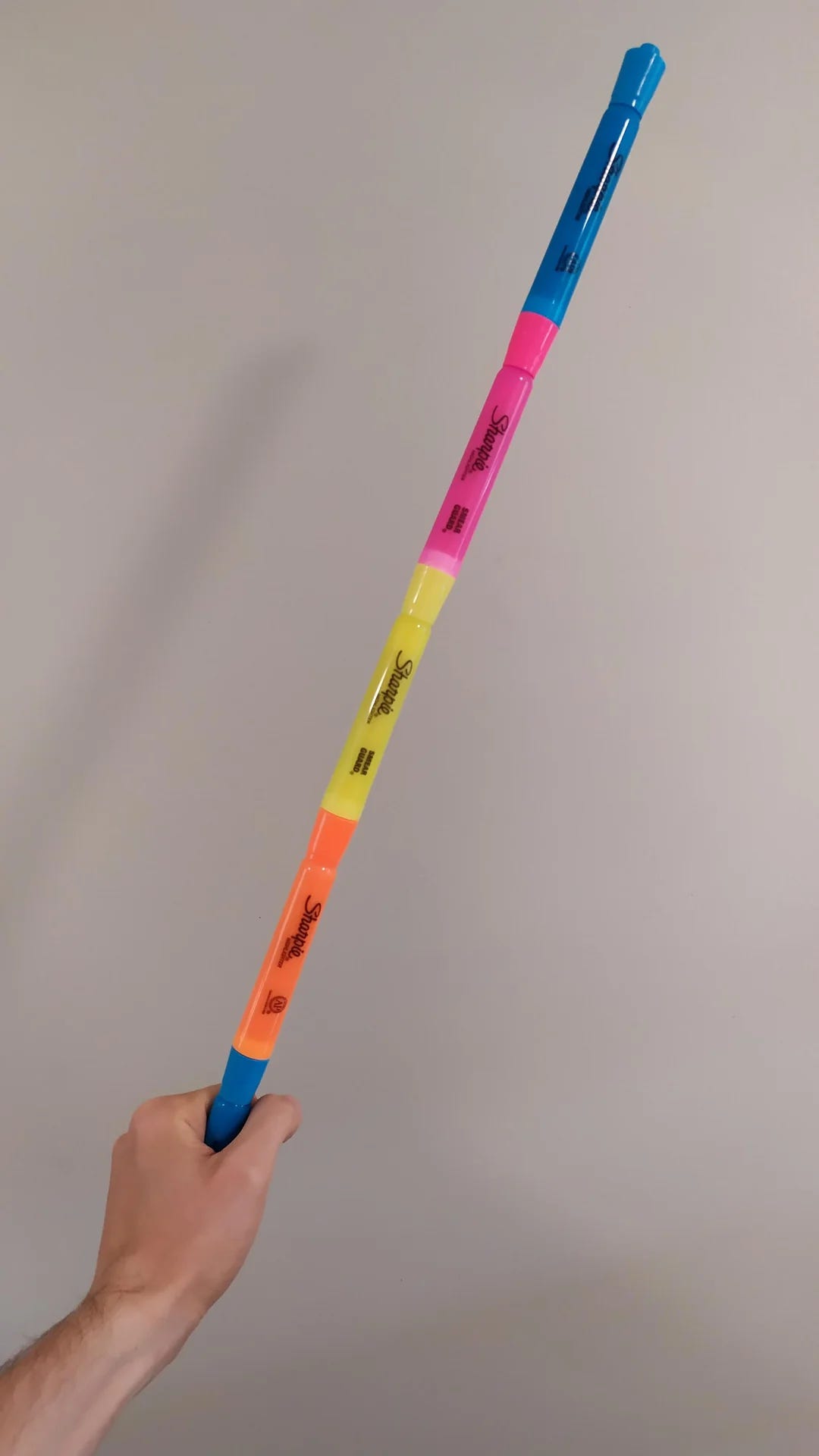
The key grip waited for a lull in the conversation, then said, “What if he did this to escape? He could make a really long one to reach the keys on the table.” He waved it around, and the stick snapped apart, sending the individual highlighters rolling around.
Everyone laughed, and immediately agreed it would be a funny bit for the actor to struggle keeping it together. (Everyone except the prop guy, who was going to have to figure out how to make a really long stack of highlighters that wouldn’t snap in half the moment you reached out with it.)2
Not My Job
It’s not the editor’s job to write dialogue, or the key grip’s to come up with comic bits. but the directors and writers in both cases had clearly signaled their creative difficulty. More importantly, they had fostered a sense of collaboration and willingness to hear other ideas. Neither of these guys just walked up to their boss and said, “Hey, you know what you should do?”
I, however, made that exact mistake on a different show.
It was a fast-paced, action series, with lots of fights and explosions and such. In an upcoming script, I read the main character was going to return to a location that had been destroyed in a previous season. I don’t mean like damaged; I mean pretty much nuked. There was no place to return to.

Per WGA rules at the time, on a show with as many episodes per season as we had, at least two scripts had to be written by non-staff writers. This particular episode was written by the script coordinator. He was new that season, and I thought maybe he just hadn’t watched the whole series before being hired. So I waited for a time when he was alone in his office, and pointed out the continuity error. He thanked me because he didn’t realize that, and he’d fix it in the next draft.
Later that evening, my boss called me into his office and berated me. He told me the script coordinator was livid that I was “trying to steal his job.” I should shut the hell up and do mine.
When you’re a PA, you can’t just give unsolicited advice, even if you’re totally, absolutely, 100% correct, like I was. It’s about personalities and timing as much as anything. Are they open to feedback? Have they said they’re looking for input?
The other thing to bear in mind is the fact that you don’t have the whole picture in your mind. You don’t know what practical considerations and studio politics went into the writing of a scene, the casting of an actor, or even the overall funding of this ill-conceived project over another one.
A good writer, producer, director, or whatever will let you know if they’re creatively stumped, and in need of some help. But even the most collaborative filmmaker is under enormous pressure from their bosses, and doesn’t need half the crew pitching ideas at them from every direction.
Keep your brilliant ideas to yourself. Or better yet, save them for your own projects.
something to button-up the scene, a piece of dialogue or action that makes the moment seem complete. Comedies, unlike dramas, need a piece of witty dialogue to transition from one scene to the next — or, in the case of sitcoms that take place in communal areas (the coffee shop in Friends, for instance; or the living room in The Big Bang Theory) they need funny moments to cover the entrance or exit of a character.
He wound up drilling holes down the barrels of the highlighters, and sliding a thin, metal pole down the middle.
"You guys are still getting PA jobs?"
This is good advice. Sad to hear about that script coordinator incident though.